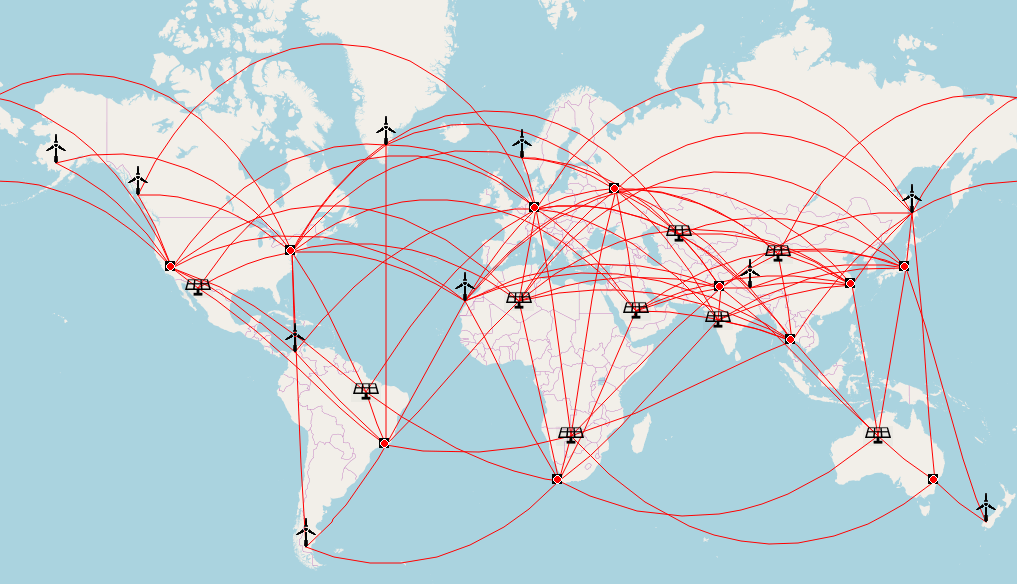
It could be as simple as this. Substitute fossil fuels with low carbon energy.
But the dimension of the a global energy transition is rarely debated. We must speed up rapidly, dramatically with the installations. It is very unlikely that we get there by 2040. And even that would probably be too late.
The good news: The technology is available and affordfable today, in contrast to many other approaches. Fossil fuels account for about 70% of the greenhouse gas emissions. The mass deployment of wind power, PV and a supergrid in combination with some storage technique seem to be the last chance to avoid the irreversible impacts of a global warming. This will not stop the process but eventually slow it down. And it has a positive side-effect: Wind, sun and also hydro energy will last forever. This site contains some background and estimations about quantities and magnitudes of a global energy transition.
2028
The countdown [countdown] is running: If emissions do not drop, the carbon budget for 1.5°C will be exhausted after 2028[sr15]:96. Global warming could become irreversible and uncontrollable. Even if it was possible to achieve negative emissions in the future, 1.5°C must not be exceeded at any time to avoid the loss of ecosystems. The consequence: Radical emission cuts are required immediately. We are on the brink.
Slowing down is not enough if you rush towards the cliff !
Leave it in the ground !
Coal, oil and gas exploiters have never paid for the damage they cause. It's time to start with high carbon pricing above 200$/t per CO2 equivalent. Not many other regulations are required. With carbon tax or a tight concept of carbon certificates, large scale investments into renewable energies will start all by themselves. Wind and solar already outbeat coal, oil and gas in hours where they are available. But still, grids and storage is needed for a 24/7 supply. This needs a little boost. Competitiveness is the key to a global energy transition. The amount of emission certificates must be limited to the carbon budget for 1,5° for all time with no exeption and include all sectors globally. This would be more diffult to manage than a simple carbon tax. Renewable energy needs fair market conditions, power net access and international cooperation. The transition to 100% renewable energy would probably be cheaper than the trillions yet to spend on oil, gas and coal. Once installed, operation costs for wind and solar are low - a long term benefit for society.
PV is cheap
1 US cent per KWh for utility scale in the desert[pv1] is much less than any fossil fuel can offer. And the price is dropping. In remote areas, there is much space for solar PV and wind plants. Installation is possible without any resitance by local residents and the land is cheap. In populated areas, 5c/kWh are common, still competitive.
Fossil import countries: Stop losing billions!
Money spent on oil and gas will be gone for good. Domestic wind and PV projects keep the money at home and generate wealth. No dependence anymore. This is the main reason why China has chosen this path.
Coming to a solution
- Invest in wind, solar, storage and grids. And hurry up!
- Ramp up production capacity for wind and solar facilities, battery and hydrogen storage, HVDC cables, electrolysers and converter stations
- Connect the continents for 24/7 wind and solar availability: Long distance powerlines (UHVDC) lose only 1.5% per 1000 km[uhvdc] The sun always shines somewhere. If the supergrid is strong enough, requirements for expensive storage systems decrease drastically
- Energy storage will still be required. Pumped hydro and compressed air (underrated) are effective for long-term storage, supplemented by batteries for shorter cycles and lossy hydrogen.
- Avoid fussil fuel investments of US$ 11 trillion[reu] which would be needed to keep up fossil production (for only a few more years)
Hesitation will cost you more
Fossil reserves are limited. A transition to renewable energy must happen sooner or later. These investments cannot be avoided. The only question is when. Companies involved in coal, gas and oil exploitation are interested to slow down the process. They want their gains for a few more years. The money spent on fossil fuel is lost to the public. So even without climate change it would be wise to push forward a global energy transition.
It is illusionary to hope for any change of habits. The world population wants energy. The global energy demand increases by 2 - 3 % per year. The only possible answer is a massive installation of wind and solar power in remote areas. Renewables can compete already now.
Tasks
A complete world trasition to renewables is neccessary within 15-20 years
- Ramp up production capacity for wind power, PV, solar CSP, HVDC cables, converter stations
- Inventor friendly conditions for renewables
- 200 $/t carbon tax or more including CO2-equivalents for methane and nitrous oxide and F-gases
- Balance storage and grids for maximum efficiency
- Support science for more effective prodution of these
- Export opportunities: China, USA, India, Australia and Russia (some day) should become aware of their chances to install and export huge amounts of PV and wind power
- Forest fires counting for about 10-20% of CO2 emissions must stop.
- Meat consumtion: Beef is problematic. Boost substitutes.
- Low-carbon agricultuture: There are sustainable alternatives to fertilizers and practices
- Plastic production counting for about 2% of carbon emissions must be widely replaced by organic substances.
Can a change in lifestyle be the solution?
The debate about climate change is often dominated by appeals to avoid air travel, meat and plastic. Awareness is essential, much can be avoided. But even if a part of the world's wealthy population change their habits, this would only reduce global emissions by a few percent. There is no alternative to replace fossil energy with wind, solar and hydro power.
Please read on:
- In depth: Climate change and energy transition
- Heat Pump Calculator Heat pump vs natural gas: life cycle calculation with many options
- In a nutshell: Brief basic knowledge
 auf Deutsch
- Strom-Simulator für 100 % Erneuerbare Energien
- Energiewende global - umfassende Infos
- Abenteuer Wärmepumpe Eigene Erfahrungen von der Planung im Bestandsgebäude bis zu den ersten Verbrauchswerten
- Wärmepumpen-Rechner Wärmepumpe vs Gastherme: Vergleichsrechner mit vielen Optionen.
- Wärmepumpen - Was kostet die kWh? Die Rechnung ändert sich: Selbst im unsanierten Altbau sind Wärmepumpen im Verbrauch inzwischen günstiger als Gasthermen
- Abenteuer E-Auto 2 Jahre mit dem e-up. Ladestrom, Emissionen, wichtige Details aus der Praxis, die eher selten zu lesen sind.
- Erfahrungen von der Installation einer 10WKp-PV-Anlage auf dem eigenen Hausdach
- Photovoltaik Ertragsberechnung
- Klimawandel kurz erklärt
- CO2-Preis-Rechner Wie teuer wertden Strom/Transport/Wärme/Nahrung? Mit und ohne Methan, interaktiv mit gleitenden Werten
- CO2-Mengen vom Standby bis zur Flugreise mit interaktivem CO2-Steuer-Rechner (CO2 footprints with carbon tax calculator), Vorläufer
- Drei Phasen bis zu Null Emissionen 100% im Strommix sind noch die einfachste Übung
- EE Statistik-Blog Auffälligkeiten aus den Energy-Charts
- Power 2 X Wie aus grünem Wasserstoff Biomethan und Ammoniak wird
- CCS in Schleswig-Holstein Chronik 2009-2012 zu den Plänen für die CO2-Verpressung, den Protesten und dem resultierenden CCS-Verbot